

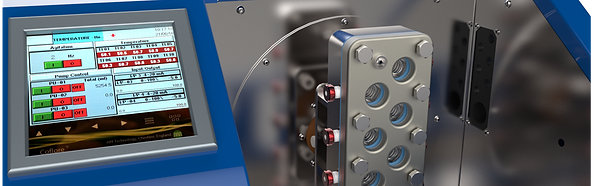

Dr Reddy’s scales crystallisation from laboratory to manufacturing with Coflore
Dr Reddy’s Laboratories has scaled continuous crystallisation of atorvastatin calcium through AM Technology’s Coflore ACR, ATR and RTR reactors, progressing from laboratory development to a validated manufacturing process now operating at 12 kg/h of API output.
The work demonstrates a practical route through the Coflore range while addressing a persistent misconception in flow chemistry: that processes involving slurries are unsuitable for continuous manufacturing.
Research published in Organic Process Research & Development describes how the team controlled crystal form, managed fouling and developed a slurry suitable for downstream filtration and drying.

Challenging the misconception about slurries in flow
Solids can present real difficulties for conventional tubular flow reactors. Particles may settle, accumulate on reactor walls or cause blockages, particularly during crystallisation, where solids are deliberately formed.
Dr Reddy’s encountered this challenge directly. Initial trials in conventional tubular reactors suffered severe fouling within minutes. Trials using stirred-tank crystallisers produced mixtures of solid forms rather than consistently delivering the required atorvastatin calcium trihydrate Form I.
Coflore’s patented dynamic mixing technology provides a way to process slurries in continuous flow. Mechanical agitation supplies mixing energy independently of the process flow rate, supporting solids suspension even at low throughputs and long residence times. This helps mitigate settling and fouling while retaining the residence time needed for the process.
Across the Coflore range, active mixing is combined with staged reactor designs that limit back-mixing. For Dr Reddy’s, this combination helped establish the conditions needed to consistently produce the target crystal form and promote crystal growth.
Coflore ACR: developing the crystallisation process
The team developed the laboratory process using the Coflore Agitated Cell Reactor (ACR), demonstrating an API output of 5.6 g/h. The ACR’s series of actively mixed cells provides near plug flow conditions, behaving as 10 CSTRs in series. This allowed the researchers to investigate the effects of temperature, seed loading, residence time and antisolvent addition on crystallisation.
The resulting process combined seeded antisolvent crystallisation with controlled cooling, using isopropanol as the solvent and water as the antisolvent. Optimised conditions included crystallisation at 65°C, 5% seed loading and a solvent-to-antisolvent ratio of 1:4.
Cooling proved equally important. Direct cooling to 25°C produced fine particles that restricted filtration. Introducing three stirred tanks after the ACR allowed staged cooling through 55°C, 45°C and 25°C, promoting crystal growth.
The laboratory system was evaluated over seven days, with scheduled cleaning every six hours, to assess robustness and fouling behaviour.
Coflore ATR: proving the process at pilot scale
The next stage transferred the process to the Coflore Agitated Tube Reactor (ATR), achieving a throughput of 0.6 kg/h. Pilot trials retained the key conditions established in the ACR, including crystallisation at 65°C, 5% seed loading and the same solvent-to-antisolvent ratio. The ATR operated with a 15-minute residence time, followed by staged cooling in three stirred tanks. Analysis confirmed Form I in samples collected throughout the cooling sequence, demonstrating successful transfer of the crystallisation strategy to pilot throughput.
Coflore RTR: reaching manufacturing throughput
The process was then scaled to the Coflore Rotating Tube Reactor (RTR), reaching the target manufacturing throughput of 12 kg/h. Trials at 65°C verified the laboratory operating conditions at the larger scale, followed by controlled cooling and rotary pressure filtration. Powder X-ray diffraction confirmed the required Form I after filtration and drying.
The RTR process also produced larger crystals than the laboratory system, supporting effective downstream filtration. The reported filtration capacity was 800 litres of slurry per hour, equivalent to 12 kg of dry product per hour, balancing the upstream throughput.
The study also reported a reduction in wet-cake water content from 48% to 33% compared with batch crystallisation. This improved material handling and reduced drying time.
The wider opportunity: operating costs, energy and waste
Continuous flow manufacturing offers opportunities to reduce energy requirements, waste and operating costs compared with batch processing.
A 2025 peer-reviewed assessment of seven pharmaceutical processes found that flow manufacturing delivered significant average improvements in energy efficiency, water consumption and waste reduction. Average operating costs were also lower, although the difference was not statistically significant across the seven processes, highlighting the importance of evaluating each application individually. At AM Technology, our engineering team can assist and perform process evaluation and techno-economic analysis (TEA) at an early stage in process development to enable your business to make an informed decision on whether to proceed with development. Find out more on our engineering services here.
For the Dr Reddy’s process, the reported improvements in filtration and drying illustrate how crystallisation development can benefit subsequent manufacturing operations. The paper does not quantify overall energy, cost or waste savings for this process.
A demonstrated route through the Coflore range
From 5.6 g/h in the ACR to 0.6 kg/h in the ATR and 12 kg/h in the RTR, Dr Reddy’s increased throughput by more than 2,000 times while maintaining control of the target crystal form.
The work demonstrates that slurry crystallisation can be developed and scaled in continuous flow when reactor design, mixing and process conditions are addressed together. Coflore’s dynamic mixing platform enabled that progression from laboratory investigation through pilot trials to manufacturing.
Read the research:
To discuss slurry processing, continuous crystallisation and scale-up across the Coflore range, contact AM Technology at sales@amt.uk.

